
What Is Horse Oil? A Plain Guide to Ingredients, Features, and How It Differs from Petroleum Jelly
Horse oil (bayu) is an animal-derived oil obtained from the subcutaneous fat of horses and the like. It is said to have properties close to human sebum, and because it blends well into the skin, it is used for dry-skin care and for moisturizing the whole family. This page explains what horse oil is, the characteristics of its components, how to use it for babies and sensitive skin, and even the differences from jojoba oil and petroleum jelly, in a way that is easy to understand for first-timers.

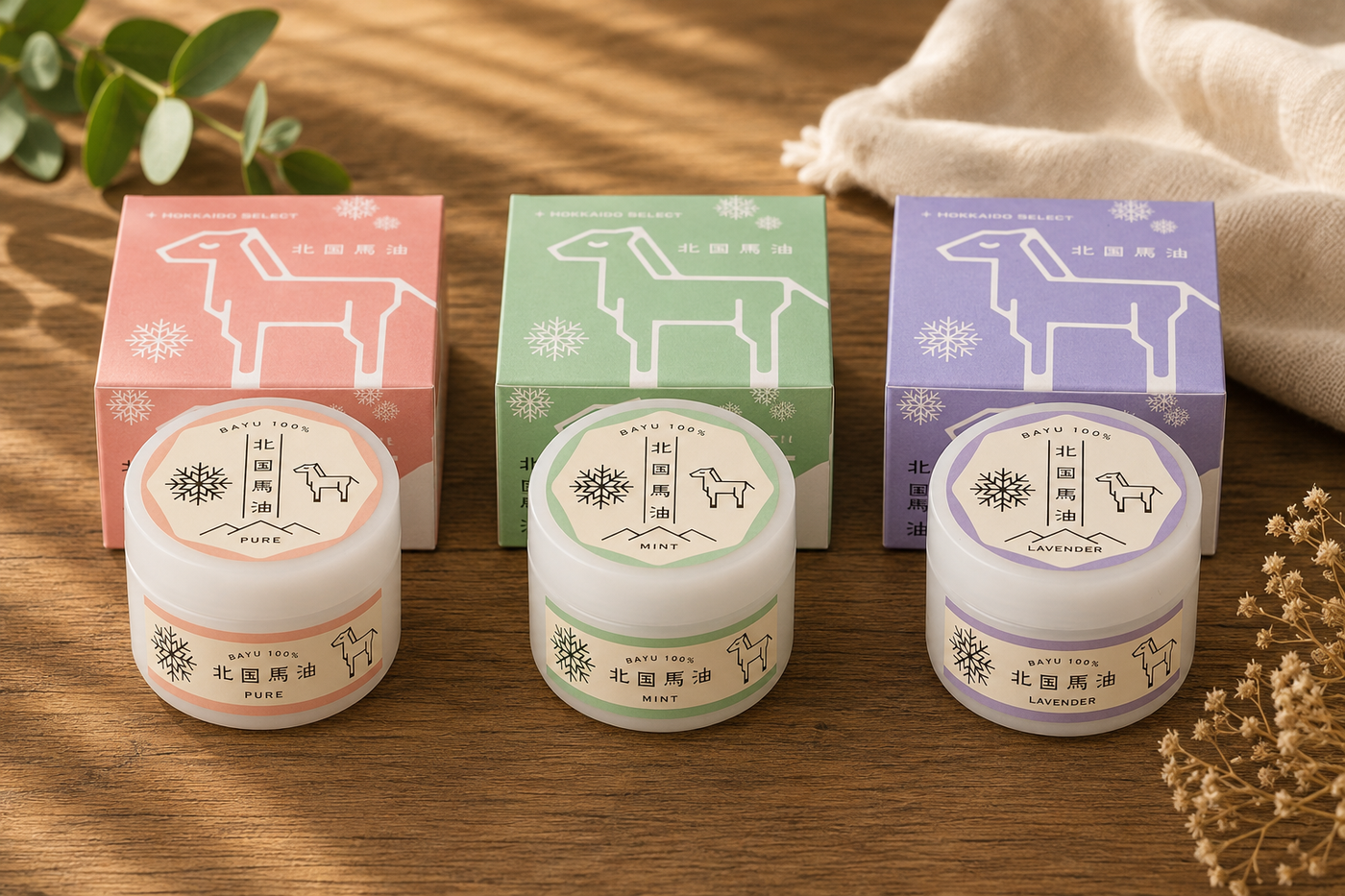
What is horse oil? (Definition, raw material, history)
Horse oil (bayu) is an animal-derived oil obtained from the subcutaneous fat of horses and the like. In Japan, it is a folk material that has long been used for caring for burns and rough skin, and today it is familiar as a skincare oil or cream intended for moisturizing.
The history of horse oil is long, and its origin is said to go back to traditional folk remedies handed down in China. It reached Japan long ago and has been used for many years as an "all-purpose oil" passed down in households. In recent years, advances in refining technology have made it possible to produce horse oil with little odor and good spreadability, making it easier to adopt in everyday skincare.
Horse oil is an "animal-derived oil." It is said to have properties close to human sebum and is characterized by blending easily into the skin.
How to read "馬油" (horse oil)
Horse oil is written 馬油 in Japanese and read "bāyu" (ばーゆ). "Ba" is the on'yomi (Chinese-derived) reading of 馬 (horse) and "yu" is that of 油 (oil). It is sometimes written "bayu" (ばゆ), but both refer to the same horse oil.
In product names it is often written in hiragana as "ばーゆ." If you are unsure how to read it, remembering "bāyu" is enough.
Main components and characteristics of horse oil
Horse oil contains a good balance of fatty acids that give moisture to the skin. In particular, it contains a lot of the unsaturated fatty acids that are also found in human sebum, which characterizes how horse oil feels to use.
Fatty acids close to sebum
It contains unsaturated fatty acids close to human sebum and is said to blend easily into the skin.
High moisturizing power
It gently covers the surface of the skin, preventing evaporation of moisture and keeping it moisturized.
Light feel
Although it is an oil, it is not very sticky, and its charm is the good spreadability that blends in smoothly.
* Individual experiences vary. This is not intended for the treatment or prevention of any specific disease.
Moisturizing benefits of horse oil
The moisturizing benefit of horse oil is that it gives moisture to the skin and protects it from dryness. It contains unsaturated fatty acids that are also found in human sebum and is said to blend easily into the skin.
When applied, it gently covers the surface of the skin, giving moisture and preventing evaporation to protect the skin from dryness. Because it is not very sticky and spreads well, it is easy to use on both the face and body.
We recommend applying a small amount when your skin is still moist, such as after a bath. It spreads well even in small amounts, so the key is not to use too much.
* Individual experiences vary. This is not intended for the treatment or prevention of any specific disease.
Use for babies and sensitive skin
Because it is mild with little irritation, horse oil is also chosen for moisturizing babies' skin and by people with sensitive skin. In particular, additive-free horse oil (no parabens, synthetic fragrances or colorants) whose raw material origin is clear is attractive because the whole family can use it with peace of mind.
When using it for the first time, it is reassuring to try a small amount on the inside of your arm or the like before using it on your face or body. If it does not suit your skin, please stop using it.
Differences from other oils (jojoba and petroleum jelly compared)
There are many kinds of oils used for skincare. Here, we have organized the differences in origin and feel between the representative "horse oil," "jojoba oil" and "petroleum jelly." Please use this as a reference for choosing according to your purpose and preference.
| Horse oil | Jojoba oil | Petroleum jelly | |
|---|---|---|---|
| Origin | Animal-derived (horse fat) | Plant-derived (jojoba seeds) | Mineral-derived (from petroleum) |
| Main property | Contains fatty acids close to sebum | Mainly composed of wax esters | Covers the skin surface firmly |
| Absorption into skin | Blends in easily | Blends in easily | Tends to stay on the surface |
| Feel | Light, spreads well | Silky and light | Moist, slightly rich |
| Suitable use | Moisturizing the whole body, shared by the family | Light care for the face, hair and so on | Protection of specific areas such as lips and heels |
* The table above is a guide to general characteristics. Formulation and feel differ by product.
What we care about in Kitaguni Horse Oil Pure
How horse oil feels to use changes greatly depending on the quality of refining. Hokkaido Select's "Kitaguni Horse Oil Pure" is handled in Hokkaido from material selection to manufacturing, and finishes the original gentleness of horse oil in a form that is easy to use every day.
Repeated refining and filtration
To carefully remove impurities, refining and filtration are repeated many times. That is why the finished oil is less likely to bring the characteristic odor often found in horse oil.
A feel with little oddity
Odor and stickiness are kept down, making it easy to use on the face and the whole body. It is a finish that is easy to adopt even for those trying horse oil for the first time.
Handmade at our factory in Hokkaido
Made one by one by hand at our own factory in Hokkaido. With small-scale manufacturing under careful watch, we finish each product with attention to quality.
Frequently asked questions about horse oil
What skin types is horse oil suited for?
It suits people who are concerned about dryness or who want moisturizing that blends easily into the skin. Because it is gentle, it is also chosen for sensitive skin and for moisturizing babies. If you are concerned, please do a patch test before use.
Does horse oil have a distinctive smell?
Kitaguni Horse Oil uses our own refining method, aiming for a finish where the smell is hard to notice, so it is easy to use even if you have the impression that "horse oil smells."
When is the best time to use horse oil?
We recommend using it when your skin is moist, such as after a bath. Gently work it in as if sealing in moisture, and your skin will stay hydrated more easily.
What should I look for when choosing a horse oil?
The key is to choose an additive-free formula in a size that suits your use. Kitaguni Horse Oil comes in a 60g size for generous use and a 20g size that is handy to carry. We also offer subscriptions for continued use at a better price.
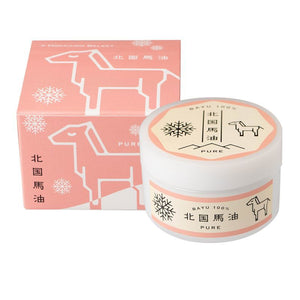
"Kitaguni Horse Oil Pure," 100% horse oil
Additive-free, 100% horse oil. A gentle one that the whole family can use, from pregnancy and after birth to babies.
In charge of product planning and quality control for horse oil and other ingredients. Involved from raw material selection through formulation design, working to make products the whole family can use with peace of mind.
This article is intended to provide general information and is not intended for the diagnosis, treatment, or prevention of any specific disease. If you have concerns about your skin condition, please consult a professional.